Governance & Transparency
The Just Energy Transition Investment Platform (JETIP) is overseen by a clear governance framework that aligns national policy, financing, and local priorities to deliver a fair transition. The system includes a high-level council, a national coordinator, a technical unit, thematic working groups, and two regional forums that bring local voices into decision-making.
How JETIP is governed
Just Transition Council (JTC): The Council is the highest decision-making body in the JET governance system. It sets overall national policy direction, identifies priority areas on an annual basis, mobilizes financial resources, and approves major investments and strategies. The members of the JTC are the Ministers representing the following Ministries: Ministry of Energy, Mining and Mineral Resources as the National coordinator, Ministry of Environment and Spatial Planning, Ministry of Finance, Ministry of Economy and Labour, Ministry of Social Affairs and Youth, Ministry of Agriculture and, Ministry of Local Self-governance, ESM, MEPSO and NOMAGAS. The Council operates based on voting: a majority vote (more than 5 out of 10 members) is required for project approval, while more sensitive or high-impact projects require a two-thirds majority. The Council receives regular updates from MoEMMR, the working group members and the Technical Support Unit, and can request further analysis when needed.

Our Partners





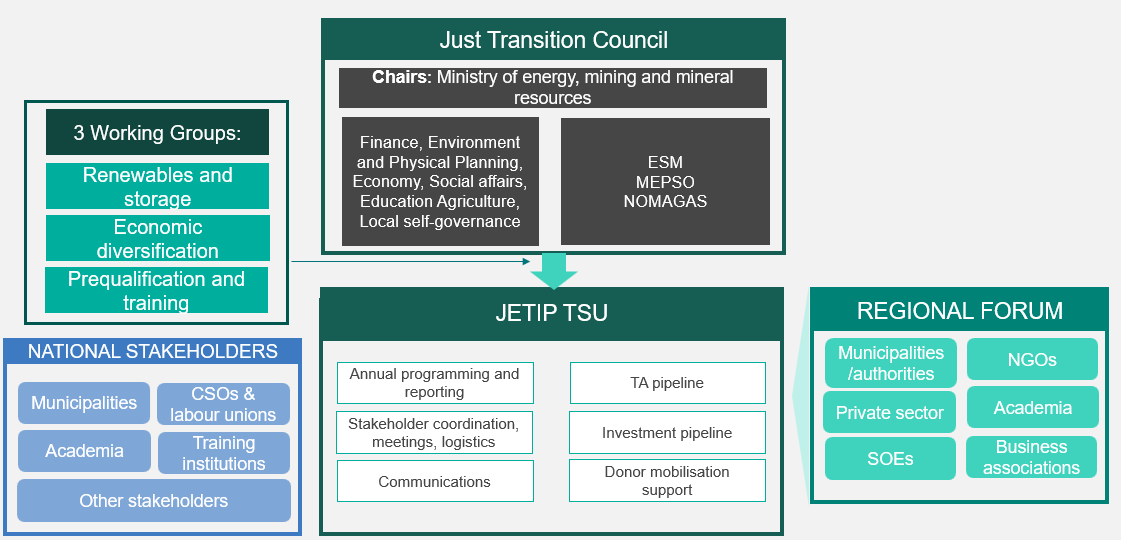
Governance Structure & Working Groups
Technical Support Unit (TSU): Manages day-to-day implementation of the JETIP. It supports the Council and the Steering Committee by organizing meetings, preparing workplans,managing the project pipeline, and monitoring implementation. The TSU ensures coordination between all actors and alignment with strategic objectives.
- Focuses on the technical and regulatory aspects of the energy transition, including renewable energy deployment, energy efficiency, and decarbonization strategies.
- Develops action plans for achieving national energy targets in line with international climate commitments.
- Coordinates with the Ministry of Energy and the TSU on technical aspects of energy projects, such as grid modernization and renewable energy investment.
- Analyzes the economic implications of the energy transition, focusing on sectoral transformation, economic diversification, and new job opportunities.
- Proposes economic policies that support the development of green industries and sustainable jobs.
- Collaborates with the Investment Forum to identify areas for investment in emerging industries and technologies that will drive economic growth.
- Focuses on workforce development and labor market adjustments, ensuring that the transition is fair for workers.
- Identifies skill gaps and designs training programs to reskill and upskill workers from traditional energy sectors to new, green industries.
- Collaborates with educational institutions, vocational training centers, and businesses to develop job-specific training and qualification frameworks.
- Ensure that the transition process reflects regional and local priorities.
- Act as coordination bodies between the central government and local stakeholders, ensuring that local development needs and challenges are addressed.
- Organize consultations and dialogues with local businesses, civil society organizations, and residents to align local initiatives with national transition plans.
- Report to the Working Groups and TSU on regional progress, challenges, and needs.
| Timetable | Working Groups Meetings | JT Council | JETIP Partners |
|---|---|---|---|
| February 2026 | 26.02 | - | - |
| March 2026 | 26.03 | 31.3 | |
| April 2026 | 17.04 | - | - |
| May 2026 | 21.05 | 19.05 | 20.05 |
| June 2026 | 18.06 | - | - |