North Macedonia’s power utility Elektrani na Severna Makedonija has secured a EUR 1.5 million grant to strengthen its capacity and accelerate the energy transition.
Elektrani na Severna Makedonija (ESM) made a major step toward a market-driven green transformation with a grant implementing agreement with Germany’s KfW Development Bank, providing EUR 1.5 million in technical assistance funded by the European Union, aimed at strengthening internal capacities and accelerating key activities for the company’s energy transition.
The agreement formalizes a EUR 1.5 million technical assistance grant to boost the state-owned utility’s corporate and green transition processes.
The support will strengthen ESM’s institutional and commercial capacities, enable further investments in renewable energy, and prepare the company for integration into the European energy market, according to a social media post by Steffen Hudolin, Head of Cooperation at the European Union’s Delegation to North Macedonia.
“The EU grant, enabled through KfW, represents a strategic cornerstone for our institutional transformation into a comprehensive, green, and market-oriented company. For ESM, this is more than a shift to renewable energy sources, it is a serious commitment to becoming a modern and commercially competitive force in the European energy market. The funding will serve as a tool to strengthen our internal capacities and corporate governance by financing critical initiatives for modeling and strategic planning. This institutional focus ensures our operational sustainability, strengthens the country’s energy security, and significantly accelerates our efforts to reduce our carbon footprint,” said ESM Director-General Lazo Uzunchev.
Steffen Hudolin, Head of Cooperation at the European Union’s delegation in North Macedonia, said accelerating the green transition has never been so close and so possible.
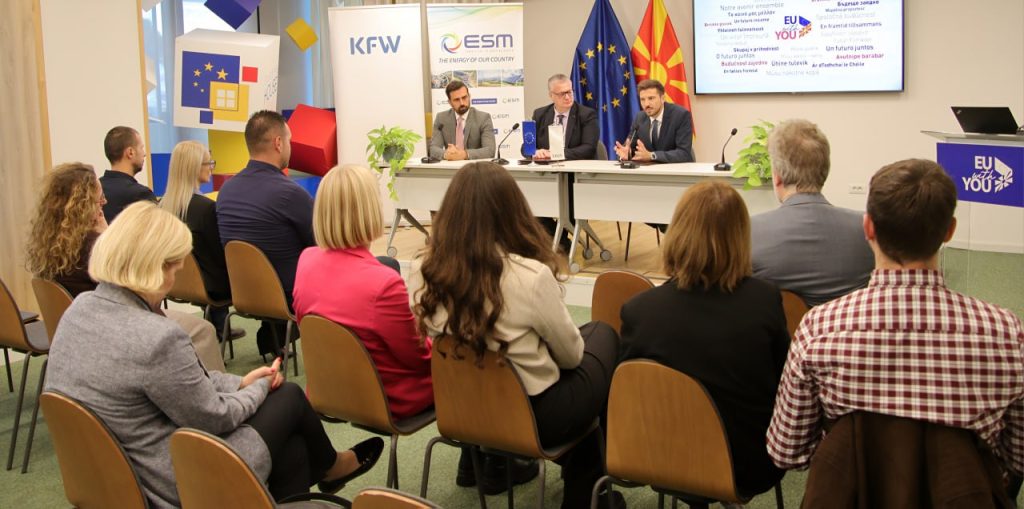
“With support from the European Union and guarantees from EFSD+, the country will receive financial resources and technical guidance from our partners at KfW to accelerate the transformation and decarbonization of North Macedonia’s energy sector. This joint action has a transformative effect in shifting from coal to green energy, while also contributing to the creation of a stable energy sector in a highly volatile climate and geopolitical environment,” Hudolin said.
According to German Ambassador Petra Drexler, Germany has supported the energy transition of public energy facilities in North Macedonia for the past 20 years.
“In addition to financial engagement, the German development bank KfW is also providing expertise with technical leadership and management. Decarbonization is a matter of teamwork, and Germany and KfW are committed to continuous support for North Macedonia on this path,” Drexler said.
Pablo Obrador, head of the Division Energy and Transport for Southeast Europe and Türkiye at KfW, stressed that the energy transition requires prepared energy companies capable of handling challenging conditions.
“With this project, KfW will support the transformation of Power Plants of North Macedonia (ESM), enabling them to better position themselves and helping improve their efficiency and market readiness,” Obrador stressed.